

Japan’s traditional performing arts can feel intimidating to a first-time observer – the rituals are elaborate, the pacing is often unfamiliar, and it’s not always obvious what you’re supposed to be watching for. But sumo, kabuki, and noh each reward a little context enormously. Once you understand what’s actually happening on stage or in the ring, these art forms go from confusing to genuinely captivating. Here’s what a first-timer should know before experiencing each one.
Sumo: More Ritual Than Sport
Sumo is often described as Japan’s national sport, but treating it purely as athletic competition misses most of what’s actually happening. Rooted in Shinto ritual, sumo matches are preceded by an elaborate sequence of ceremonial movements – salt throwing to purify the ring, stomping to drive away evil spirits, and a slow, deliberate stare-down between opponents – that can take longer than the match itself, which is often over in a matter of seconds.
What to watch for: The pre-match ritual is not filler; it’s the point. Pay attention to the dohyo (the ring itself), which is considered sacred ground, and to the rankings system, since sumo wrestlers (rikishi) compete within a strict hierarchical structure that determines everything from their salary to their hairstyle privileges. Tournaments (honbasho) run for 15 days, six times a year, and tickets to watch in person are genuinely accessible to visitors, unlike some of Japan’s more insider-only cultural experiences.
Kabuki: Drama Turned Up to Eleven
Kabuki emerged in the early 1600s as a form of theater originally performed by women, though it evolved into an all-male tradition after the Tokugawa shogunate banned women from performing, citing concerns about public morality. What resulted is one of the most visually striking theater traditions in the world: exaggerated makeup, elaborate costumes, dramatic poses called kata, and a performance style built around big, stylized emotional moments rather than naturalistic acting.
What to watch for: Look for the hanamichi, a walkway extending into the audience that actors use for dramatic entrances and exits, often accompanied by a specific rhythmic wooden clacking sound that signals a key moment is coming. Also watch for onnagata – male actors specializing in female roles, a highly respected and specialized skill within kabuki rather than a simple substitution. Many theaters offer English-language earphone guides, making kabuki considerably more approachable for first-time foreign audiences than its reputation might suggest.
Noh: Japan’s Oldest Surviving Theater Form
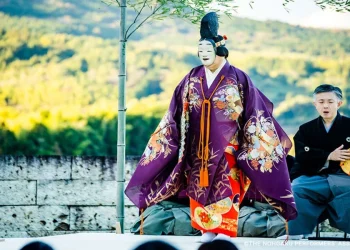
Noh predates kabuki by centuries, with roots tracing back to the 14th century, and it operates on an entirely different emotional register. Where kabuki is loud and visually dramatic, noh is deliberately restrained, minimalist, and slow, built around masks, sparse staging, and movement so controlled it can look almost like meditation in motion. Noh plays traditionally draw on themes of spirits, ghosts, and the supernatural, often centering on a character who is later revealed not to be entirely human.
What to watch for: Masks are central to understanding noh – a skilled performer can convey dramatically different emotions through subtle shifts in how a fixed mask catches the light, a technique that rewards close, patient attention. The minimal set design and slow pacing are intentional, meant to create a meditative atmosphere rather than hold attention through spectacle. First-timers often find noh the hardest of the three to appreciate immediately, but many describe it as the most rewarding once the pacing starts to click.
How These Three Compare
| Sumo | Kabuki | Noh | |
|---|---|---|---|
| Origin | Ancient Shinto ritual | Early 1600s | 14th century |
| Pace | Fast, ceremonial buildup | Dramatic, dynamic | Slow, meditative |
| Visual style | Ritual purity, minimal costume | Bold makeup and costume | Masks, sparse staging |
| Best for first-timers | Most accessible | Most visually engaging | Most rewarding with patience |
Where to Experience Each One
Tokyo remains the most reliable city for experiencing all three traditions, with the Kokugikan arena hosting major sumo tournaments, the Kabuki-za theater serving as kabuki’s flagship venue, and the National Noh Theatre offering regular performances with English program notes. Kyoto and Osaka also host respected kabuki and noh performances, often in smaller, more intimate venues than Tokyo’s larger theaters.
For travelers building a Japan itinerary that includes multiple cities, Japan cruises that call at ports near Tokyo, Kyoto, or Osaka can make it possible to catch a sumo tournament or evening kabuki performance as part of a broader trip, without needing to build an entire standalone visit around a single city’s performance schedule.
For up-to-date tournament dates and theater schedules before you go, official cultural and tourism resources covering Japan’s traditional arts offer scheduling details that are easy to miss otherwise.
Watching With New Eyes
None of these traditions are designed to be immediately obvious to an outside observer, and that’s part of what makes them worth the effort. A sumo match becomes far more interesting once you understand the ritual isn’t a delay before the “real” event – it is the event. Kabuki’s exaggeration stops feeling strange once you see it as a deliberate visual language. And noh’s stillness starts to feel less like nothing happening and more like everything happening slowly enough to actually notice. A little preparation turns confusion into genuine appreciation.